


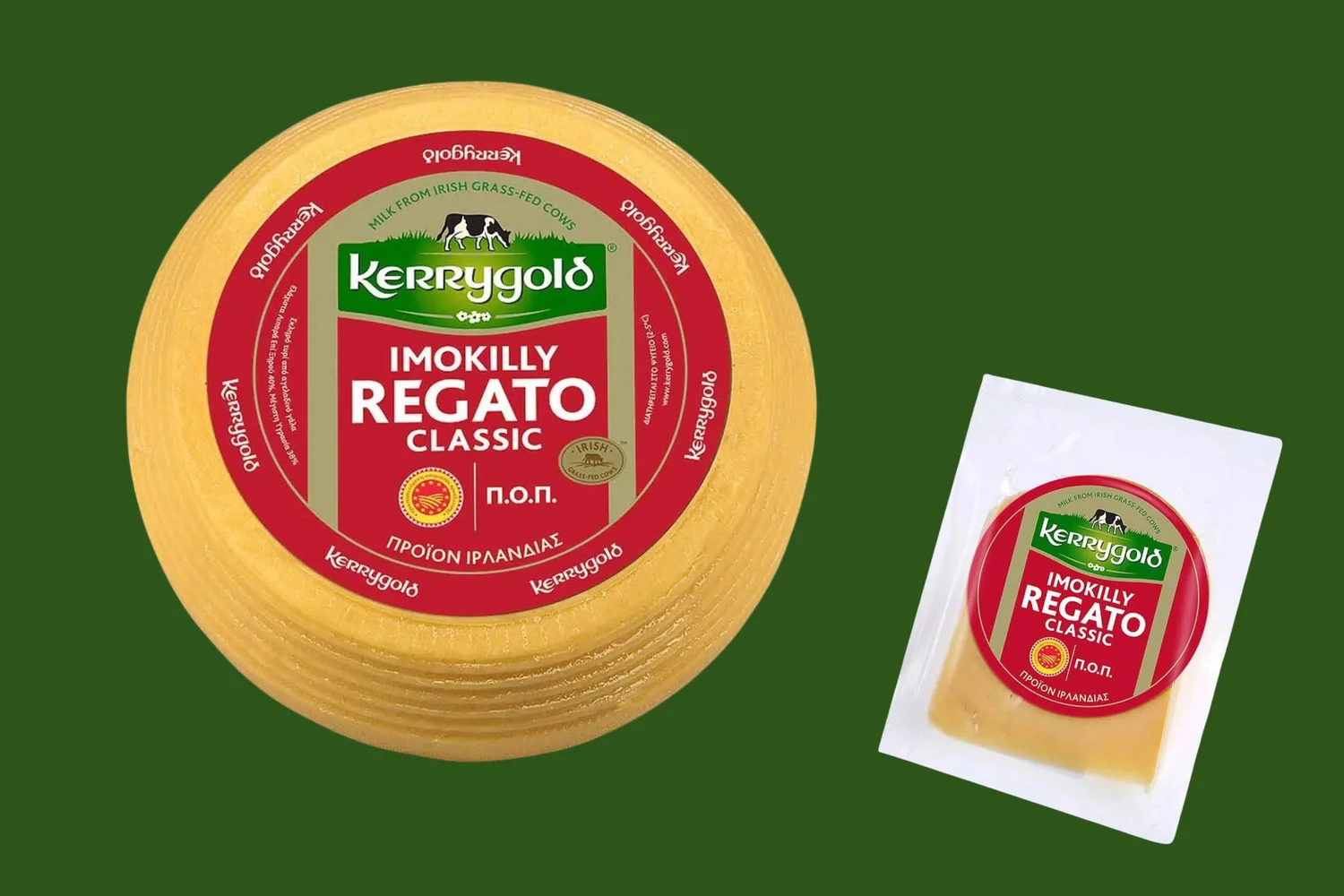
Regato was born between the merging of two industrial dairy cooperatives in Ireland’s southernmost County Cork in 1973, just ahead of the Irish farmstead cheese renaissance. (More on that moment to come.) Wanting to show off County Cork’s unparalleled milk supply, which contains a high level of beta-carotene given weather conditions that allow for an extended grazing period, a new cheese to establish the new operation was called for, using a historic, regional recipe and rennet cultivated specifically for this new expression. A special mold gives Regato its signature shape: a small wheel with convex sides embossed with a Celtic cord pattern.
With Irish milk and an Irish design, Regato’s Italian name is due to its intentionally Italian Grana nature: finely cut, cooked curds are pressed into molds, then wheels of Regato are salted twice before aging out for at least nine months. This process is shared by Italian PDO cheeses such as Parmigiano Reggiano and Grana Padano. As a result, Regato is a distinctly culinary cheese: perfect for “pizzas, jacket potatoes, pasta dishes, and savoury bakes, including quiches,” according to Dairygold. Given the above tasting notes, like its Italian cousins, it’s doubtlessly also good for snacking.
The pursuit of a PDO for a cheese that was already a kind of tribute cheese unto itself speaks more to the size of the industrial brand(s) behind it, than to the risk of it being replicated. Speaking from experience, it’s a devil to even find. Admittedly, I have yet to go to County Cork, but neither Ireland’s biggest grocers, its largest cheese seller, nor a few specialty shops between Galway and Dublin have even heard of it, much less carry it. Compare that to something like France’s Comté, which is as ubiquitous as Italian mozzarella. You may more easily find Regato keeping company as shreds with mozzarella and other “Mediterranean” cheeses in Dunnes Stores packaging than you would whole wheels or wedges. It even seems that it may be easier to find in Germany or Greece than in Ireland.